|
|
|
|
GETTING ON THE LOW BANDS
As those
sunspots kept getting lower in numbers and the higher HF bands were
opening less and less I found myself looking more at 40m, 80m and 160m or
top band as its known. So I put up an inverted V for 40m and this was a
squeeze where I live but it was resonant and works very well with a feed
point at 22ft above ground.
Thats the 40 meter inverted V above and the feed point at 22 ft above ground in the photo. Each leg is a 1/4 wave and follows the pitch of the roof about 1ft above the tiles.
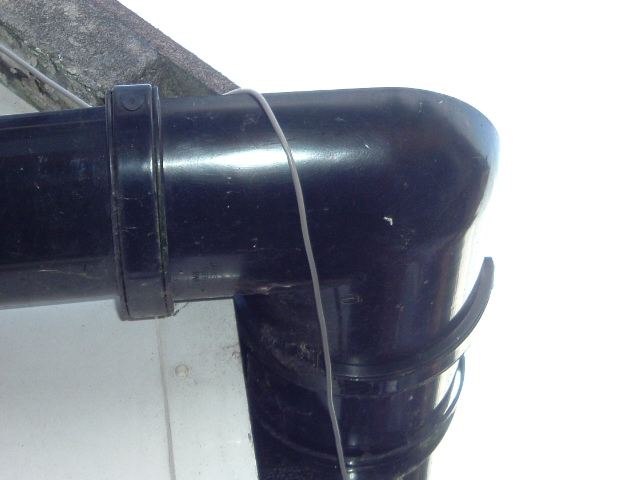
The style of house I live in is a Dormer and the gutters are about 7ft above the ground. This is where the legs do a 90-degree bend and are tied to the gutter for about the ten feet or so that remains. This works a treat, has a low SWR and is fairly stealthy. You have to look for it or you would probably not know it was there. As soon as I put it up there was no activity on 40m! Typical, so went onto 20m, tuned it up with an ATU and straight away worked a station in Kuwait! Now its cut for 20m, is fed with coax so theres going to be losses there and who knows how much of my 50w was being radiated? That's 40m taken care of with a
resonant antenna that works very well so where do I put a half wave dipole
for 80m? I can only just get a 40m dipole up and now realizing how good
resonant antennas are over random / long wires, there is no going
back. Secondly, TVI to the neighbors on 80 and 160m. Doublets were never going to fit
that would get me on 80m so it was back to the drawing board and a look at
what was being used by other Hams in such a position. In one of many experiments
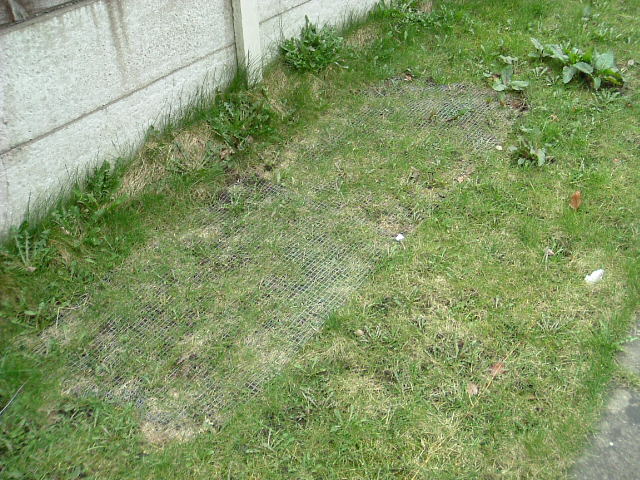
later I decided to lay a piece of wire mesh on the lawn and pinned it down
with some bike spokes bent like tent pegs. These were very kindly donated
by M3PZO. The mesh is about 6ft long and 18 inches wide. I then cut a
length of wire for 20m and sloped it to the low gutter, tied it off
and checked SWR. It was below 2:1 without any cutting, so I thought I
would try it with 50w. I worked all over Europe with ease and
to my surprise this antenna fed against the ground worked. I thought
you needed a high feed point or at least get it as high as possible? Not
if your using the earth as half the antenna which in its self has just
halved the size of a half wave dipole and seems to work well without using
the ATU therefore reducing losses in the ATU and the coax feeder as it has
something around 50 ohms at the feed
point.
Here is a drawing above showing the 80/160m antenna. I cut the 80m leg at 67ft and trimmed for best SWR at 3.5mhz (UK bottom part of 80m). Due to the narrow bandwidth on a wire antenna on 80m you will need to use an ATU. The feed point is at ground level and the radiating wire goes up over the house and into a top room window where I have a crocodile clip (acting as a switch), to attach the 160m section. The 160m leg is another 63ft and has a loading coil 4ft long with about 40ft of wire space wound on it to reduce the length as I was pushing getting this thing on my small footprint of land. The remaining length, about 10 feet, goes up to the ridge of the roof where the 40m inverted V is mounted.
Here is the earth matt above in
the photo ,about 1 1/2 X 6 feet, and you may need to
do more than this depending on where you live and your ground situtation.
The feed point is on the left lower corner out of the picture.....I'm
lucky, I live on very wet ground. It's a peat bog and in fact my house is
on a concrete raft and known as a floater!
With the clip lead coming from
the 80 meter end and connected to the 160 meter section in the photo
above, now I am resonant on 160m with a loading coil that I couldn't
avoid.
The loading coil is pictured
above up on the roof. It's
construction consists of about 40 feet of wire wrapped around the 4
foot form with around 63 feet total of wire used in the complete 160
meter addition to the antenna. When you add the 80 meter length
to this, you get about 130 feet total wire used with the 80 and 160
section tied together.
http://www.csgnetwork.com/antennaevcalc.html
|